When Flexibility Becomes a Business Advantage
Organizations must quickly enhance their digital presence. Marketing needs speed, operations demand efficiency, IT seeks secure and low-maintenance systems, and leadership wants platforms that accelerate growth.
As these pressures intensify, it becomes crucial to revisit platform strategy. In this context, the conversation around the composable digital experience platform has become more relevant.
This is not just a trend. Many businesses hear terms like headless, composable, decoupled, and modern digital stack and assume a total rebuild is needed. The key question is: Is your platform advancing your business or holding it back?
For some organizations, a traditional all-in-one platform still makes perfect sense. For others, especially those dealing with complex content, e-commerce growth, multiple brands, or integration-heavy operations, a more flexible architecture can create real business value. The key is knowing the difference.
This guide is designed to help you evaluate that decision clearly. We will break down what composable architecture actually means, where a headless CMS strategy fits in, when modernization makes sense, and when it does not. Most importantly, we will look at how to modernize without adding unnecessary complexity.
What does a composable digital experience mean
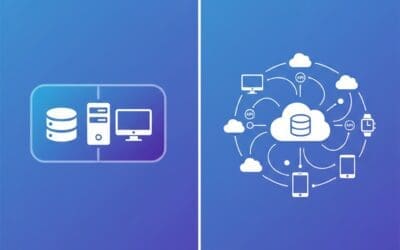
In plain language, composable architecture means building your digital ecosystem from connected parts rather than relying on a single platform to do everything.
In a traditional monolithic system, your CMS, frontend presentation, plugins, templates, and often parts of your ecommerce or marketing functionality are tightly bundled together. That can be convenient at first because everything lives in one place. But over time, that convenience can turn into a constraint.
A composable digital experience platform takes a different approach. Instead of forcing a single platform to handle every requirement, you choose the systems that best fit each business’s needs and connect them. That might include a CMS, an e-commerce engine, a search platform, a CRM, analytics tools, personalization tools, and custom frontend applications.
This is where people often confuse composable with headless, so it helps to clarify the differences between the two terms.
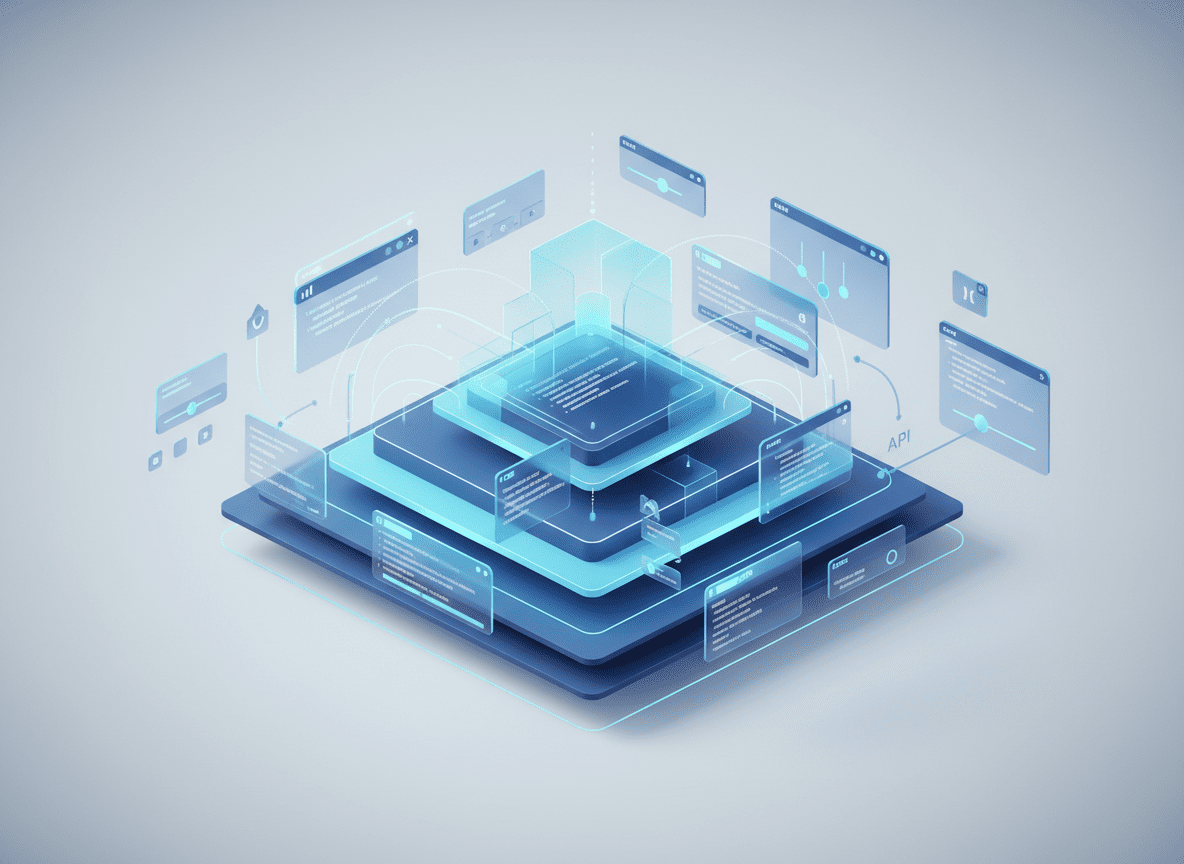
A headless CMS separates the presentation layer—the “head”—from the content management system. This lets content be stored in one place and delivered to different front-ends through APIs. Typically, adopting a headless CMS is the first step toward greater architectural flexibility, but it primarily focuses on separating content from presentation.
Composable goes further than headless by creating a digital ecosystem of specialized, synchronized tools.
Composable vs. monolithic at a glance
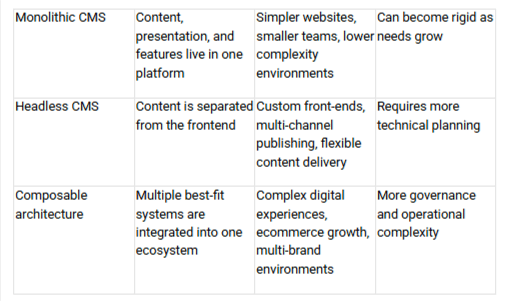
Composable architecture for websites is about flexibility with intention—supporting performance, scalability, and better digital operations.
Signs your current digital experience platform is holding you back
Most organizations do not wake up one day and decide they have outgrown their platform. It usually happens gradually.
At first, the issues seem manageable. A few extra plugins. A custom workaround for a CRM integration. A performance patch here, a content bottleneck there. But over time, those small issues start to stack up, making the platform harder to manage, slower to evolve, and more expensive to maintain.
Here are some of the most common signs.
Slow updates and content bottlenecks
If simple content changes require developer involvement, or if your marketing team has to work around rigid templates just to launch a campaign, your platform may be limiting agility. That is often one of the earliest signs that your system is no longer aligned with how your business operates.
Limited integrations
Many growing organizations need their websites or e-commerce platforms to tightly integrate with CRM, analytics, marketing automation, ERP, or support systems. If integrations are difficult, fragile, or require too many plugins and patches, the cost of staying on the current platform increases.
Performance constraints
Speed matters. So does stability. If your platform struggles under traffic, loads too slowly, or becomes harder to optimize due to legacy themes, plugins, or a tightly coupled architecture, it affects both user experience and business outcomes.
Difficulty supporting multiple channels or custom experiences
Businesses managing multiple websites, brands, regions, or touchpoints often face limitations with rigid systems. The same applies when custom front-ends are needed beyond what standard themes support.
Rising maintenance costs
A clear sign of misalignment is when your team spends more time on workarounds than on improvements. This issue quickly shifts from technical to operational and financial.
When headless or composable is the right move
A headless CMS strategy or broader composable approach makes sense when flexibility is tied directly to business needs.
That usually happens in a few common scenarios.
Complex content models
If your content extends beyond just pages and blog posts, a headless approach can help. Organizations with structured content, reusable content blocks, product data, resource libraries, or content that needs to appear across multiple channels often benefit from decoupling content management from presentation.
Multi-site or multi-brand environments
Managing several websites, business units, or regional experiences within a single rigid platform can quickly become difficult. A composable model can make it easier to centralize content operations while still supporting different front-ends, user journeys, and brand requirements.
Custom frontend requirements
Some organizations need more than a templated website for interactive experiences, personalization, application-like interfaces, or unique ecommerce flows. In those cases, a flexible frontend architecture is preferable.
E-commerce growth and integration needs
A headless ecommerce architecture can be especially valuable when a business needs to connect product data, checkout systems, search, inventory, analytics, and marketing tools in a cleaner, more efficient way. As e-commerce operations mature, integration quality becomes just as important as design.
Scalability and future flexibility
A scalable platform is crucial when change is expected—new brands, channels, acquisitions, or requirements all add pressure. Composable approaches allow adaptation without full rebuilds when priorities shift.
When it is not the right move
This part matters just as much as the upside.
Not every business needs a composable stack. In fact, many do not.
If you have a simple website, a few integrations, a small team, and basic content needs, a monolithic platform may be best. Simplicity can outweigh flexibility when lower overhead and easier training bring more value.
A composable model may also be the wrong fit if:
- Your team does not have access to ongoing technical support.
- Governance and ownership are unclear.
- Budget is tight, and the business case is weak.
- The organization is solving for perceived innovation rather than actual business constraints.
- The platform is not the real problem, but internal process issues are
This is why the composable CMS vs monolithic CMS conversation should never be framed as old versus new. It should be framed as fit versus misfit.
A simpler, well-managed platform can outperform a more advanced architecture that is poorly supported.
A practical website modernization strategy
The best website modernization strategy starts with business goals, not platform labels.
Before choosing a platform, step back and ask what is actually driving the conversation. Is the problem slow publishing? Weak integrations? E-commerce limitations? Poor performance? Difficulty scaling across brands? Rising support costs?
Once those pain points are clear, modernization becomes more practical.
Start with an audit
Look at your current platform honestly. Where are the bottlenecks? Which systems are mission-critical? Which workarounds are costing time or creating risk? What does your team struggle with most?
Identify what can be decoupled first.
Modernization doesn’t always require full replacement. Often, phased improvements are more effective.
You might:
- Decouple the frontend first.
- Improve commerce integrations before changing the CMS.
- Consolidate multiple sites into a more structured content model.
- Move selected services to the cloud.
- Rework performance and support infrastructure before a larger rebuild
This kind of phased approach reduces risk and helps the organization learn as it goes.
Align architecture with support and governance.
A modern stack is only as effective as the team managing it. That means platform choices should reflect internal capabilities, partner support, content workflows, security requirements, and long-term maintenance expectations.
This is where experienced guidance matters. The right architecture is not just the one that looks modern on paper. It is the one your organization can operate successfully over the long term.
What decision-makers should ask before choosing a platform?
With these strategic considerations in mind, decision-makers should ask key questions before selecting a platform.
What experiences do we need to support in the next 2 to 3 years?
Do you expect to launch new brands, expand ecommerce, support multiple regions, or create more customized digital journeys? Your future needs matter as much as your current ones.
Where are our current bottlenecks?
Be specific. Is the issue related to content, operations, integrations, performance, governance, or support? A vague modernization goal usually leads to vague results.
Which integrations are mission-critical?
If your website needs to work closely with CRM, analytics, ecommerce, cloud, or marketing systems, those requirements should shape your platform decision early.
Do we have the internal team to manage complexity?
A flexible architecture can create major advantages, but only if the business has the right support model behind it.
How will this affect performance, content operations, and long-term maintenance?
A platform decision is not just about launch. It is about what happens six months later, two years later, and after the next major business shift.
Why this matters for OpenMedium clients
At OpenMedium, we see this decision through a practical lens. We work across WordPress, WooCommerce, Statamic, Drupal, Shopify, BigCommerce, and headless solutions because the answer is not always the same. Some organizations need a more traditional platform with better support and optimization. Others need a more flexible, modern digital experience platform that can support custom frontend development, deeper integrations, and long-term scale.
That range of experience matters.
It means we can help clients evaluate whether they truly need a composable model, where a headless approach fits, and how to modernize without overengineering the solution. It also means we can support the full picture, from architecture and development to cloud services, integrations, and ongoing managed support.
For many organizations, long-term support is just as important as the initial build. A platform should not only launch well. It should remain secure, maintainable, and adaptable as the business evolves.
FAQ
What is a composable digital experience platform?
A composable digital experience platform is an ecosystem of connected digital tools, such as a CMS, an ecommerce engine, search, analytics, and CRM integrations, that work together instead of relying on one all-in-one platform.
What is the difference between headless and composable architecture?
Headless separates content management from the frontend presentation layer. Composable is broader. It uses multiple specialized systems across the digital stack and connects them into one flexible architecture.
When should a business move to a headless CMS?
A business should consider a headless CMS when it needs more frontend flexibility, more structured content management, multi-channel publishing, or better support for custom experiences and integrations.
Is a headless CMS worth it for small businesses?
Sometimes, but not always. For many small businesses, a traditional platform is more practical. Headless becomes more valuable when complexity, customization, or future scale justify the added investment.
Next steps
The best architecture is not the most advanced one. It is the one that fits your business.
A composable digital experience platform can create real advantages when your current platform is limiting growth, performance, integrations, or digital flexibility. But it should be adopted for clear business reasons, not because the market is using a new language.
If your organization is evaluating a headless CMS strategy, comparing a composable CMS to a monolithic CMS, or building a broader website modernization strategy, the goal should be clarity first. Understand what is holding you back, what your team can support, and what kind of digital foundation will serve the business over the next several years.
That is the approach we take at OpenMedium. We help organizations modernize with both flexibility and discipline. If your current platform is creating more friction than value, this may be the right time to assess whether your digital experience architecture remains aligned with your growth goals. Contact us for a free consultation.